

You noticed something off.
Maybe your friend has stopped returning your texts, or maybe they laugh less, cancel plans more, or said something that concerned you on the drive home. If you are not sure what to say, and you are afraid of saying the wrong thing. This article is here to give you some tips on how to talk to your friend about mental health.
Knowing how to talk to a friend about their mental health is not about having perfect words. It is about showing up, listening, and helping them find the support they need. In 2026, the Summit County ADM board estimated that nearly 36,000 adults have struggled with a Major Depressive Episode in the past year. Because of this many concerned friends are reaching out and connecting with their friends and family in their homes, dorms, and break rooms across Akron and Summit County every day.
At Portage Path Behavioral Health, we have supported people in the Summit County community for over 56 years. This guide shares what our clinicians tell families and friends: the signs to watch for, how to start the conversation, what to say and avoid, and where to turn locally when your friend needs more than you can give.
Signs your friend may be struggling with their mental health
Everyone has hard weeks. What signals a bigger problem is behavioral change that is new for your friend, and lasts more than two weeks, or gets in the way of their daily life. Behaviors such as:
- Pulling away. Skipping plans, going quiet in group chats, or spending most of their time alone.
- Mood changes. Persistent sadness, irritability, anxiety, or flat emotions that do not seem to lift.
- Sleep and appetite shifts. Sleeping far more or less than usual, or noticeable changes in eating.
- Losing interest in hobbies. No longer enjoying hobbies, sports, work, or the people they used to love and care about.
- More drinking or drug use. Using substances to cope, numb out, or get through the day.
- Trouble functioning. Falling behind at work or school, missing bills, neglecting basic self-care or hygiene
- Hopeless talk. Saying things like “What’s the point?” or “Everyone would be better off without me.”
You do not need to be sure something is wrong before you reach out. Whether it is just one sign or a group of signs. The time to reach out is right away.
How to start the conversation
Here are a few tips to make it easier:
- Pick the right moment. Choose a quiet, private time that is not rushed, like a walk at Sand Run Metro Park, a drive, or coffee at home. Side-by-side settings often feel less intense than face to face.
- Lead with what you have noticed. Describe the behavior, do not diagnosis it: “I’ve noticed you haven’t been coming to trivia night, and you seem really tired lately.”
- Say why you care. “I care about you, and I wanted to check in.”
- Ask an open question. Typically, if you ask a yes or no question you are likely to get a yes or no answer. Asking open-ended questions can help make the conversation feel less like an interrogation and more like a casual discussion. For example: “How are you really doing?” invites more than “Are you OK?”
- Then listen. Let the silence happen. Your friend may need a moment or may not open up the first time. That is okay the important part is that they know you care about them.
If they brush it off, keep the door open: “OK. Just know I’m here whenever you want to talk.” Check in again in a few days.
What to say (and what not to say) to a friend who is struggling
Your job is to make sure your friend feels heard and less alone, not to fix the problem.
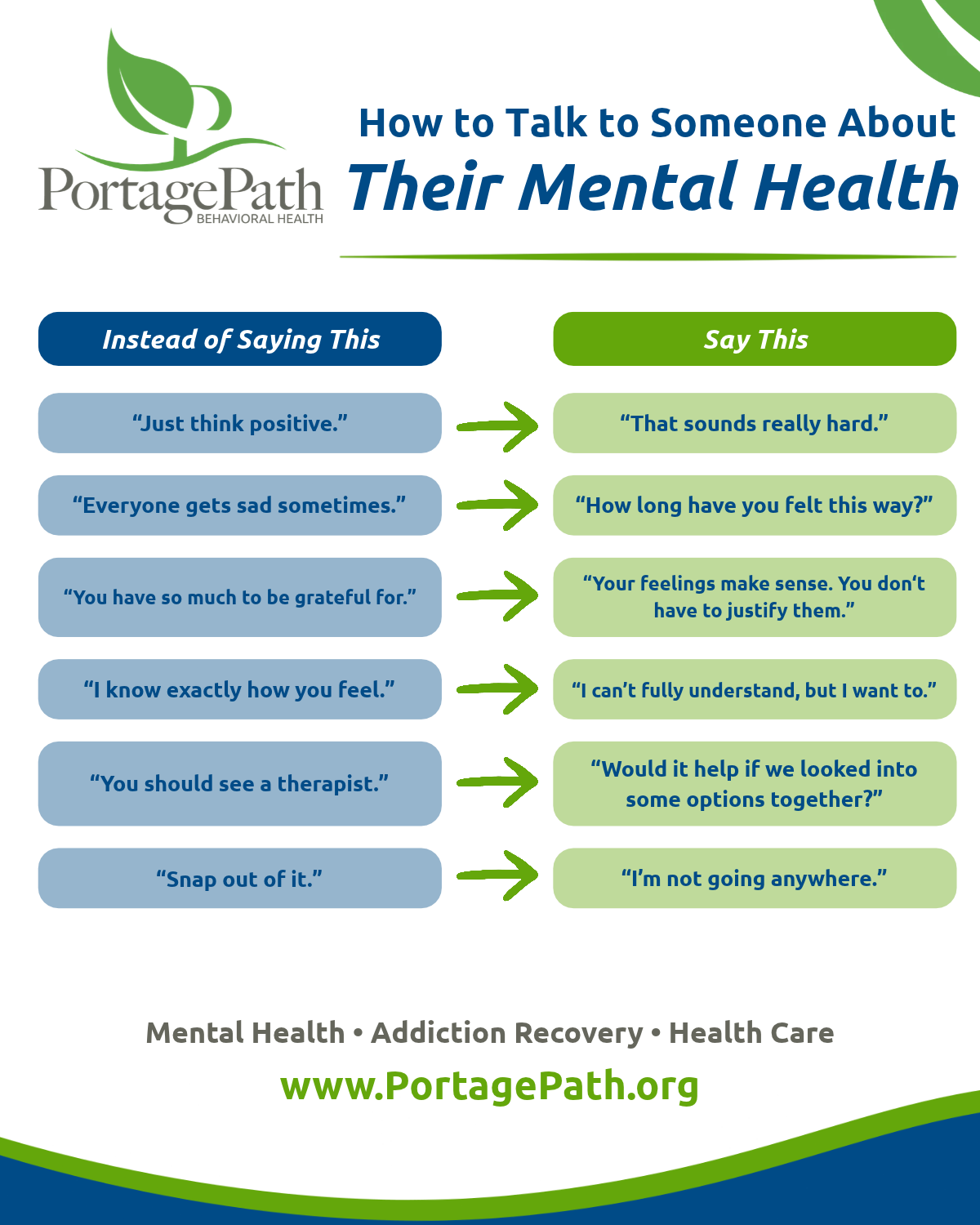
| Instead of this | Try this |
| “Just think positive.” | “That sounds really hard.” |
| “Everyone gets sad sometimes.” | “How long have you been feeling this way?” |
| “You have so much to be grateful for.” | “Your feelings make sense. You don’t have to justify them.” |
| “I know exactly how you feel.” | “I can’t fully understand, but I want to.” |
| “You should see a therapist.” | “Would it help if we looked into some options together?” |
| “Snap out of it.” | “I’m not going anywhere.” |
A few more tips:
- Listen more than you talk. Reflect on what you hear. For example: “It sounds like work has been busy.”
- Avoid judging or diagnosing. You are a friend, not a clinician.
- Do not promise total secrecy. If their safety is at risk, you may need to involve others. Be honest about that.
- Ask directly about suicide if you are worried. “Are you thinking about suicide?” Research shows that asking directly does not plant the idea. It often brings relief and opens the door to help.
If your friend is in crisis: Here is how to get help in Summit County, 24/7
If your friend talks about wanting to die, has a plan, or you believe they are in immediate danger, do not wait. Stay with them, remove access to anything they could use to hurt themselves if it is safe to do so, and get help.
- Call or text 988. The 988 Suicide & Crisis Lifeline is free, confidential and available 24/7. Calls are answered by local Summit County Crisis Counselors at Portage Path who can help create a safety plan and tell you and/or your friend about what local resources they can take advantage of.
- Portage Path Behavioral Health Psychiatric Emergency Services (PES): PES offers walk-in mental health and substance use crisis evaluations 24/7:
- Address: 10 Penfield Avenue, Akron, Ohio 44310
- Phone: (330) 762-6110
- Call 911 or go to the nearest emergency room if there is immediate danger to life.
You do not have to handle a crisis alone. Crisis counselors can also coach friends and family on what to do next and how to talk to your friend about mental health.
Helping your friend find mental health care in Akron and Summit County
When your friend is not in immediate danger but is still struggling, professional support can make a real difference. Finding it can feel overwhelming, so offer practical help.
- Look up options together. Sit with them while they browse providers or make the first call.
- Offer a ride. Transportation is a barrier for many people. Offering to drive them to a first appointment in Akron, Cuyahoga Falls, Barberton or Stow removes one more excuse and helps build in accountability.
- Normalize it. “Lots of people see a counselor. It’s like going to a doctor for anything else.”
- Respect their pace. Unless their safety is at risk, the decision is theirs.
Portage Path Behavioral Health offers clinics in Akron, Barberton and Cuyahoga Falls, we offer individual and group therapy, psychiatry and medication management, marriage and family counseling, peer support, case management, and treatment for co-occurring mental health and substance use disorders. We are proud to offer telehealth services, and our downtown Akron clinic also provides primary care and an on-site pharmacy. We accept Medicaid, Medicare and most commercial insurance plans, and offer a sliding fee scale in order to ensure that access to care is available to all. Your friend can walk in at any of our outpatient clinics or call our us at (330) 253-3100 or fill out our online appointment request to get started.
Other trusted Summit County resources include the Summit County ADM Board , which funds and coordinates local mental health and addiction services, and NAMI Summit County, which offers free support groups and classes for families and friends.
Take care of yourself, too
Supporting someone you love is meaningful, and it can be draining. It is important to remember you cannot pour from an empty well.
- Set boundaries. You can care deeply and still say, “I can’t talk tonight, but let’s catch up tomorrow.”
- Share the load. Encourage your friend to build a wider circle of support, so you are not their only lifeline.
- Talk to someone yourself. Counselors, support groups and crisis lines help supporters, not just people in crisis.
- Remember what is yours. You are responsible for showing up with care. You are not responsible for your friend’s recovery.
Frequently asked questions
How do I start a conversation with a friend about their mental health?
Choose a private, relaxed moment. Share a specific change you have noticed, say you care, and ask an open question like “How are you really doing?” Then listen without judging or rushing to fix things.
What should I not say to someone who is depressed?
Avoid minimizing phrases like “just think positive,” “others have it worse” or “snap out of it.” Instead, validate their feelings and let them know you are there for them.
What if my friend doesn’t want help?
You cannot force an adult into treatment unless they are in danger. Stay connected, keep the door open, and check in regularly. If you believe their life is at risk, call or text 988 or 911.
Is it OK to ask a friend if they are suicidal?
Yes. Asking directly and calmly does not increase risk. It shows you care and gives your friend permission to talk honestly. If they say yes, stay with them and contact 988.
Where can I find mental health help in Akron, Ohio?
In Summit County, Portage Path Behavioral Health provides [VERIFY: services] and crisis support in Akron. You can also call or text 988 anytime, or contact the County of Summit ADM Board for a directory of local providers.
One conversation can change everything
You do not need the perfect words. Noticing, asking and listening is often the first step toward someone getting help. For your friend, knowing that someone in their corner sees them can make all the difference.
If you or someone you care about in Akron or Summit County needs support, Portage Path Behavioral Health is here. Call (330) 253-3100 or request an appointment to talk with our team. In a crisis, call or text 988, any time, day or night.